
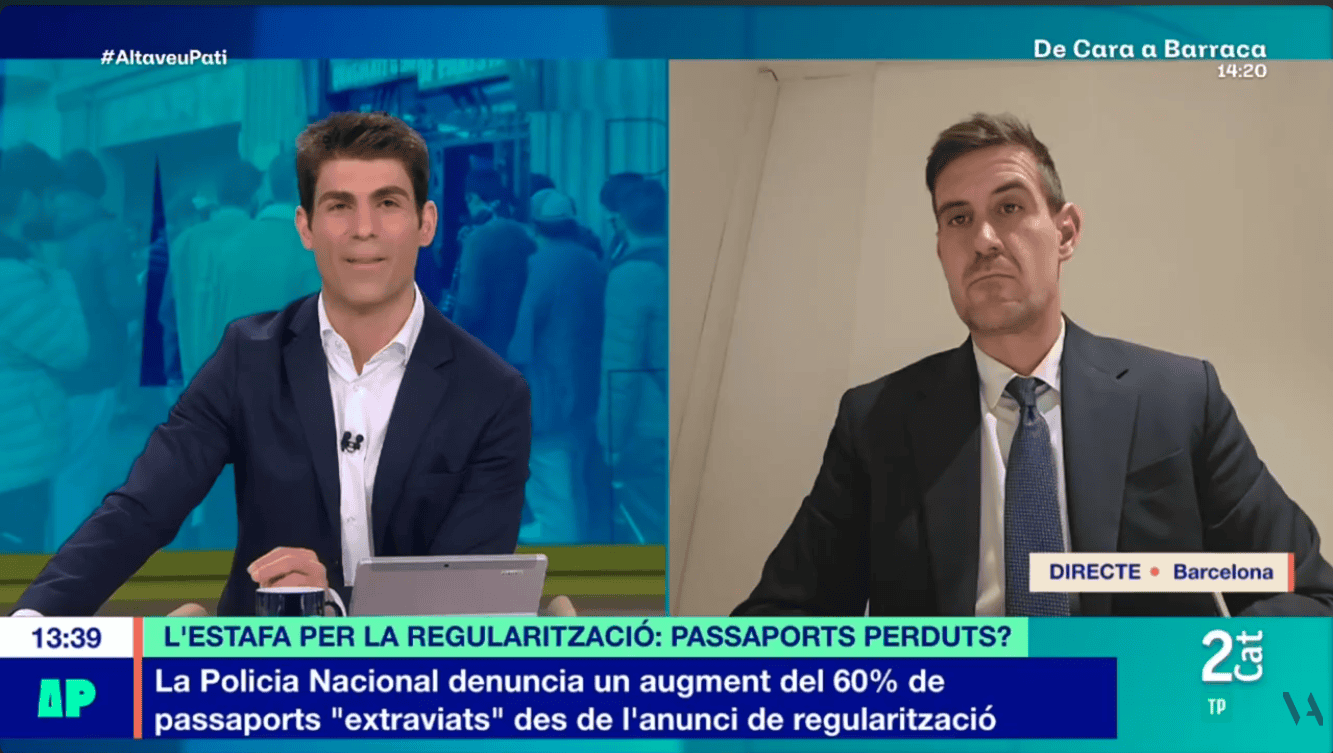
The current process of extraordinary regularization of foreigners in Spain is generating unexpected side effects. And, in some cases, worrying ones from a legal point of view. Daniel Salvador , head of the criminal law department at Vosseler Abogados , recently participated in the TVE-Catalunya program ' L'Altaveu al pati' to shed light on a phenomenon detected by experts: the disproportionate increase in reports of lost or stolen passports among the undocumented immigrant population.
The "trick" of the duplicate: Why do passports disappear?
According to Daniel Salvador, there has been a "complete disproportion" in applications for duplicate passports at consulates. Although reporting the loss of a document is not in itself an irregularity, the context of the new regulation proposed by the Government—which requires a minimum stay of eight months in the country —suggests a hidden motivation.
“We can think of two main options ,” Salvador points out. “The first is that, along with the lost document report and the consular certificate, one can falsify the actual time spent in the country. By lying about the arrival date on the new document, many seek to artificially meet the eight-month requirement to access regularization.”
The self-declaration: a breach in legal certainty
One of the most controversial points highlighted by the head of criminal law at Vosseler Abogados is the apparent lack of rigor in criminal background checks. Due to logistical difficulties in identifying individuals without passports or with duplicate documents, a practice that has surprised experts is being permitted: the self-declaration.
-
Without official verification: Instead of providing an official criminal record certificate from the country of origin, the system is accepting that the applicant declares, under their own responsibility, that they have no criminal record.
-
Lack of control: This measure, adopted in part due to administrative collapse and affiliation problems, poses an obvious risk, since it validates testimony without verifying it with international authorities.
A process that has been "overwhelmed"
For Daniel Salvador, the conclusion is clear: the administration has been overwhelmed by the logistics of the process. The speed with which this extraordinary regularization has been implemented has left "many loopholes" that can be exploited for fraud.
"This regularization process lacks the legal and necessary elements to verify with certainty how long a person has been in the country or whether they truly have no criminal record ," the lawyer concludes.
At Vosseler Abogados , we emphasize the importance of carrying out any immigration procedure in strict compliance with the law to avoid future criminal complications or the denial of permits due to document falsification.
Do you need advice on immigration or criminal law? At Vosseler Abogados, we have a specialized team led by professionals like Daniel Salvador to guide you through any legal process with the utmost guarantees.
